


You always speak English with your daughter.
She understands you perfectly.
But when she responds… she does so in the community language.
After understanding why this happens in the previous article (which you can find here), the next question is almost always:
“What can I do to help her respond in the language I’m speaking to her?”
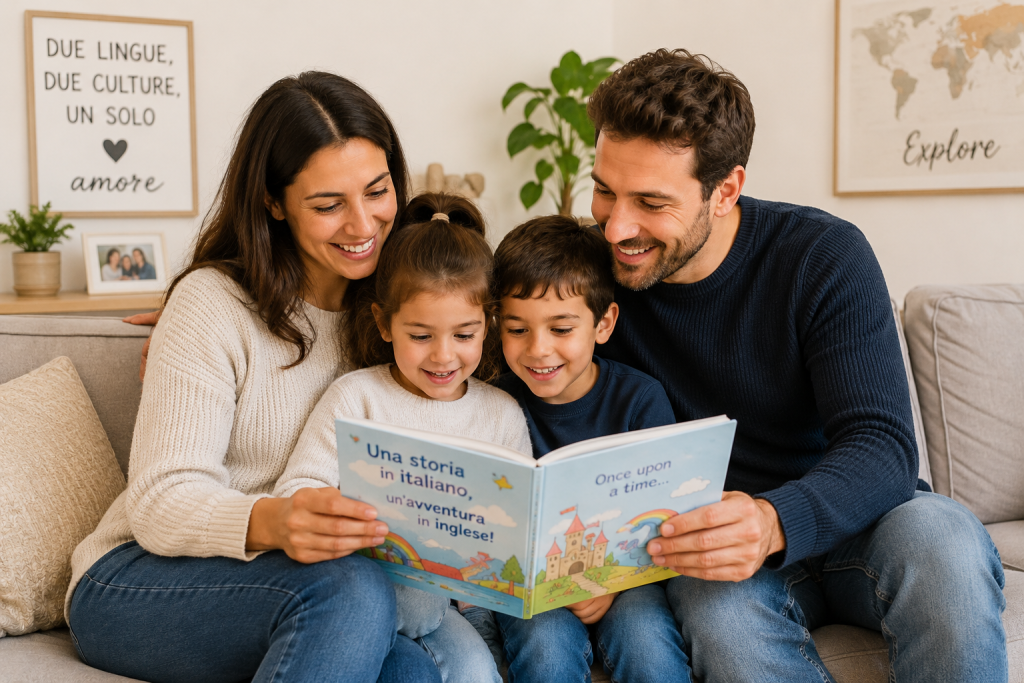
Here is the answer many parents are hoping for: you do not need to correct her constantly, pretend not to understand what she says, or repeatedly ask her to say it in English.
What truly helps is creating more opportunities where English is useful, natural, and enjoyable.
In this article, we’ll look at five practical ways to do exactly that.
1. Keep speaking English
Even if your daughter answers in another language, continue speaking English.
Every time you do, you are providing her brain with valuable input.
And input is the main driving force behind language development.
If your daughter understands you, it means English is present in her linguistic system.
Even if she is not using it spontaneously yet.
Comprehension comes before production.
2. Model the sentence instead of correcting
Imagine your daughter says:
“I want water.”
If English is your target language, an example in another language might be:
“Ik wil water.”
Instead of saying:
“Say it in English.”
You can respond:
“Oh, you want water! Here is your water.”
This way, you:
- acknowledge her message;
- provide the correct model;
- keep the conversation natural.
Children learn best when they feel heard, not corrected.
3. Create special moments in English
You do not need to speak English all day long.
Often, small daily routines are more effective, such as:
- bedtime stories;
- playing a game together;
- cooking dinner;
- going for a walk with mom or dad.
What matters most is not doing a lot, but doing it consistently.
4. Give English a real purpose
Children use a language when they need it.
That is why the following can be very helpful:
- video calls with grandparents;
- playdates with other English-speaking children;
- trips to English-speaking countries;
- books, games, and activities in English.
The more English is needed, the stronger the motivation to use it.
5. Connect English with positive emotions
Languages grow best when they are linked to enjoyable experiences.
If English becomes the language of cuddles, laughter, stories, and special moments, your daughter will be more likely to use it spontaneously.
The key message
If your daughter is not responding in English yet:
- it does not mean English is not developing;
- it does not mean you are doing something wrong;
- it does not mean it is “too late.”
It simply means she needs more time, more input, and more meaningful opportunities to use the language.
And that is completely normal.
If you have concerns about your child’s language development and would like to understand whether what you are observing falls within the normal range of bilingual development — or whether there may be genuine language difficulties — you can contact me for an individual consultation. I offer consultations in Italian, English, and Dutch.
You can find me on Instagram at @logopedistavale or through my website. I will be happy to help you gain clarity.
See you soon,

Logopedista Vale